
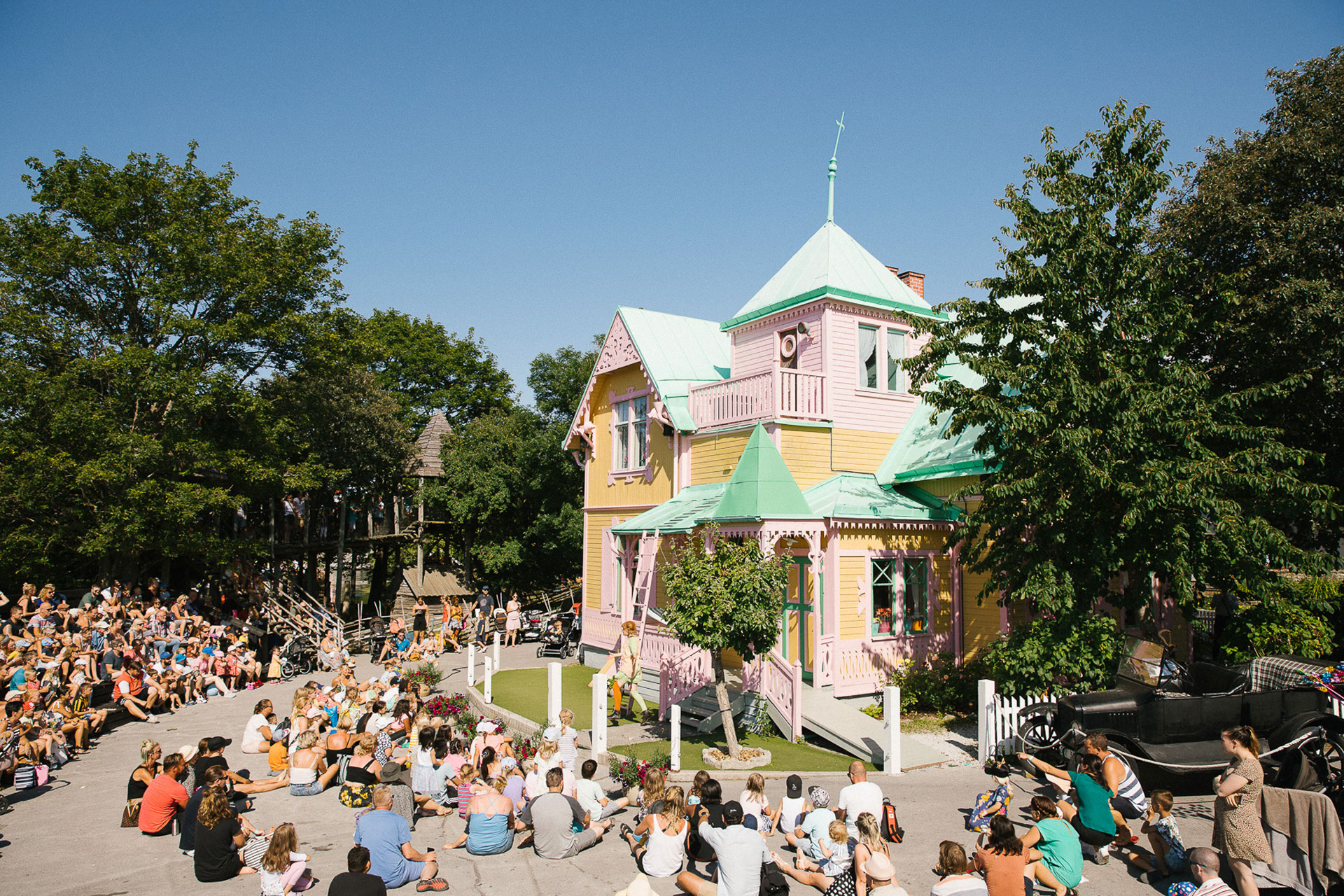


The Story of Pippi and Villa Villekulla
In the middle of the area stands the real Villa Villekulla, the original house from SVT's films about Pippi Longstocking, which is of course one of the hubs of the business. The last two films, "Pippi on the Seven Seas" and "Pippi on the Run," were filmed here at Summerland the house was moved here in 1970—in one piece! In 2001-2002, 2010, and most recently in 2015, Villa Villekulla was renovated to recreate the environment from the classic films.
About Villa Villekulla and Gotland
Villa Villekulla is a turn-of-the-century villa. Dating by E. Ahlqvist on the staircase indicates that the house was extended or built in 1902. The villa was originally a caretaker's residence with a cellar belonging to the Gotland Regiment on Visborgsslätt.
In the early 1960s, music director Åke Dohlin (Hagström 1996:91) and then dentist Bergstedt lived in the villa for a short time before the house was used as an ammunition and underwear storage facility. The caretaker's residence became known as Villa Villekulla with the filming of the Pippi series on Gotland. In 1968, the first episodes of the Pippi series were filmed.
At the end of the 1960s, Astrid Lindgren and director Olle Hellbom decided to begin filming Pippi. After finding a Pippi and an Annika, they now needed a Villa Villekulla, a Tommy, a horse, and a monkey. Olle Hellbom placed an ad in Expressen with the headline "Do you have a house for Pippi Longstocking?" with an accompanying picture of what they wanted the house to look like. The ad also specified that there should be a large tree and that it should be located in an older residential area. The ad, written with a great deal of humor, ends with "The house, the horse, Tommy, and the monkey can be sent to Nord Art, Fack, Stockholm 1." Pippi is set in an unspecified time, and they are looking for environments that resemble the turn of the last century. Gotland was chosen partly because it had not yet been fitted with the new modern traffic signs that were in use on the mainland, and therefore the surroundings still gave the impression of a bygone era. Just one month before filming begins, Olle and photographer Kalle Bergholm drive around Gotland looking for locations. They came across the administrator's residence, with its intricate woodwork and large garden, and knew it was the perfect location. Since the house belonged to the regiment, it was not a given that filming would be possible, but with a generous offer of 10,000 kronor, the then General Hjukström gave his approval.
Before filming, a veranda is added and the house is painted in bright colors. The woodwork is expanded and the windows on the lower floor are covered with shutters that are placed at an angle to mimic the illustrations in the books. The tins, spires, and chimneys are also given a skewed appearance. Only the exterior is visible in the films; the interior scenes are filmed in studios.
Thanks to the Pippi series, the old caretaker's house became one of Sweden's most famous houses. The house, which stands empty and is only used as a storage facility by the military, attracts large numbers of tourists who want to see the real Villa Villekulla. It brings Gotland a lot of attention, and the then head of tourism dreams of Villekulla becoming a playground paradise for children where juice parties can be held. But the house is still located on military grounds, which makes the villa and garden a dangerous playground.
It is described that the house is close to ruin, with large parts of the facade beginning to rot. Had it not been for Pippi, the house would have been demolished long ago. (GT 1969) The regiment is indifferent to Villa Villekulla; they will get a new storage facility and also need to expand their firing range. They would like to see the house demolished. General Hjukström believes that the Pippi craze will be over in a year or so. This attracts the attention of local newspapers as well as evening newspapers on the mainland. On May 4, 1969, Aftonbladet's Sunday edition publishes an article appealing for the preservation of Pippi's house. The house is sold at auction with the requirement that the buyer must be able to move it. Three people bid at the auction, and it is Einar Nyberg from Gotland who becomes the new owner of Villa Villekulla.
Before the move, Nyberg's machines excavate a road that will take Villa Villekulla all the way to Kneippbyn. The house is not dismantled because the frame is strong and allows it to be transported as it is. A base made of iron beams is constructed to act as runners.
Villa Villekulla was moved to a place with a long history. Kneippbyn, whose name was borrowed from the German priest and health prophet Sebastian Kneipp, was initially a health resort. Sebastian Kneipp was known for curing his tuberculosis with cold baths, barefoot walks, and fresh air, among other things. Doctor Karl Kallenberg, who bought the land south of Visby in 1907, intended to create a place inspired by Sebastian Kneipp's treatment methods, and the place was thus named Kneippbyn. In the winter of 1969, Villa Villekulla was purchased and moved by the then owner of Kneippbyn. The acquisition was in line with the development that had taken place at Kneippbyn in recent decades. In the 1970s, it was a place for leisure and family.
Once there, visitors could see the house and drink lemonade from the lemonade tree. Each visitor paid 50 öre for a glass. The staff pressed a button and sugar water flowed directly from the tree into the child's outstretched glass. In the 1980s, Kneippbyn underwent its next major change. Water slides were built and the focus was also on working on the interior of Villa Villekulla. A lot of energy was put into recreating the film's interiors in the house. Work also continued on finding the furnishings used during the film shoot. Today, you can find both Kling and Klang's Model T Ford and motorcycle in our museum. It is possible to see Villa Villekulla even during periods when Kneippbyn is closed. Email your request to info@kneippbyn.se
